【霜降節--登高舒懷】
.
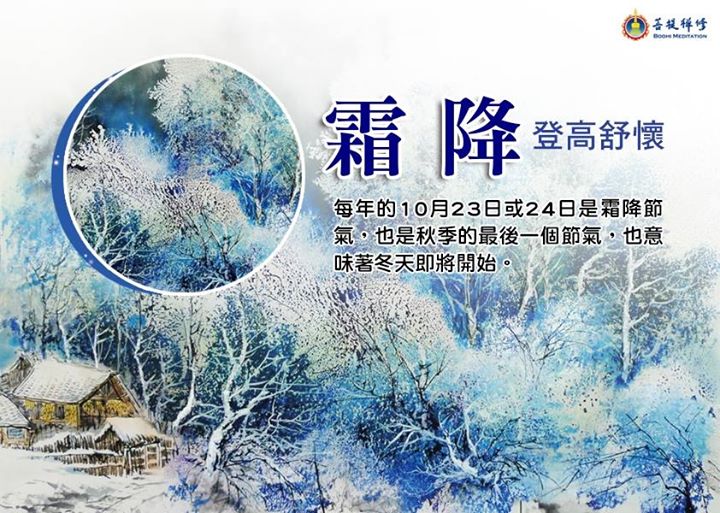
霜降是秋季的最後一個節氣,今年是在陽曆10月23日,太陽到達黃經210度。霜降節是由秋入冬的轉變,此時人體要多多儲存能量,做好禦寒保暖和運動熱身,預防支氣管炎、胃病、老寒腿的復發。
.
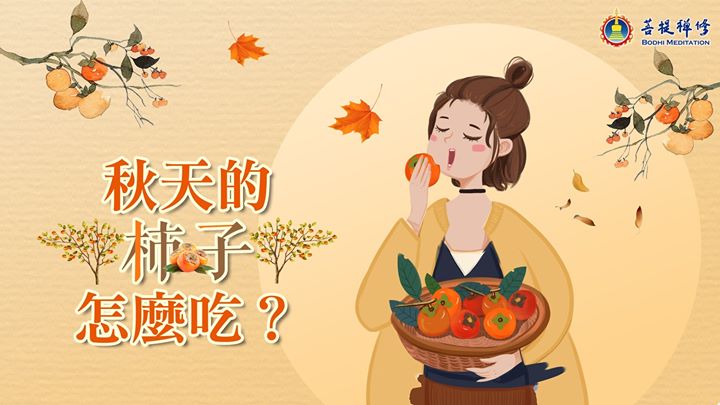
在飲食方面,民間有「冬補不如補霜降」的說法,可以適當吃些板栗、山藥、銀耳、大棗等,柿子是這一時節的當令水果,富含類胡蘿蔔素和維生素C,營養價值高,具有清熱潤肺,生津止渴,健脾化痰的功效。因此,民間有「霜降吃柿子,不會流鼻涕」的風俗,
.
霜降節氣裡有一個中國傳統節日:重陽節。《易經》中「六」為陰數,「九」為陽數,所以農曆九月九日稱為「重陽」,在這天,人們有登山遠眺的習俗,在寒冷的深秋,爬山可以鍛練肺活量,站在山頂,望著層林盡染、天高雲淡,意念「我就是大山,我就是天空,我就是宇宙」,一切得失都顯得那麼渺小,煩惱不如意悉數忘卻,重生一個無憂無愁、清心淡泊、充滿禪意的自己,這大概也算是天地人合一的一種修行吧。
.
#節氣、#霜降、#柿子
參考資料:
http://zhinan.sogou.com/guide/detail/?id=1610028881
https://www.ys137.com/slys/144104.html
http://www.weather.com.cn/zt/tqzt/08sjzt/10/62551.shtml
http://www.baike.com/wiki/%E9%9C%9C%E9%99%8DrnrnThe Day of Frost – Time to Quieten Down
The Day of Frost is the last of the autumn solar terms. The Day of Frost falls on October 23, when the sun hovers along the celestial longitude 210 degrees. It is the day when the transition from autumn to winter commences. It is also the time to start to preserve body energy, to ward off coldness and maintain warmth through exercises, and also prevent pneumonia, gastric pains and arthritis.
From the nutritional point of view, the old saying of “Boosting up at Day of Frost is always better than at winter” still applies. You can eat some chestnuts, yam, white fungus and jujube. Persimmon is one of the best fruits during this solar term as it is rich in carotenoids and vitamin C. It can also help clear the lungs, quench thirst and build on the spleen function. There’s a saying which goes as follows: “A persimmon a day keeps the running nose away”.
During the period of Frost, there is a Chinese traditional day called the Chong Yang Day. In the ancient book I Ching, the number 6 is Yin, and the number 9 is Yang. On the lunar 9th month and 9th day, it is the day of Chong Yang. On this day, it is common practice for people to track on the mountains. During the cool autumn days, climbing a mountain can help to warm and build up our lungs.
Standing amid mountains, looking at the sea of trees in the clouds, one can feel like we are the mountains, the sky and the universe. Everything seems so small, and as worries evaporates we become simple, plain and full of Zen. This is perhaps the closest we get to becoming unified with Heaven and Earth.
#SolarTerms, #Frost, #Persimmon
Reference:
http://zhinan.sogou.com/guide/detail/?id=1610028881
https://www.ys137.com/slys/144104.html
http://www.weather.com.cn/zt/tqzt/08sjzt/10/62551.shtml
http://www.baike.com/wiki/%E9%9C%9C%E9%99%8D
https://www.facebook.com/1656157281338091_2022282894725526